
Supplement label explainer
What Does Bioavailability Mean in Supplements?
In nutrition, bioavailability describes the fraction of an ingested nutrient or compound that is absorbed and becomes available for metabolic use or storage under defined conditions. It is not an absorption percentage printed on the label, a universal ranking of ingredient forms, or proof that a supplement produces a better outcome.
Short answer
The label can name the form. It cannot predict your absorbed dose.
For a supplement shopper, the practical point is that the amount on the label and the amount absorbed are not the same thing. Bioavailability can vary with the ingredient, dose, formulation, study conditions, and person.
The declared amount, % Daily Value, form, and delivery wording are separate label facts. None is a universal bioavailability percentage.
Start with the definition
Absorption is part of bioavailability, not the whole conclusion
The National Academies define bioavailability as the fraction of an intake that is absorbed and becomes available for normal metabolic use or storage. It also notes that dietary and host factors can influence that availability. 1
Absorption is the movement of a substance from the digestive tract into the body. Bioavailability asks a broader question about how much becomes available after the dose is taken under the conditions being studied. Depending on the ingredient and research question, investigators may measure an absorbed fraction, concentrations in blood over time, or another defined marker.
None of those measurements is automatically a clinical result. Greater measured availability does not by itself show that a product improves symptoms, corrects an inadequate diet, works better than a comparator, or is suitable for a particular person.
Amount swallowed, amount made available under study conditions, and health outcome are related questions, but they are not interchangeable.
Why one percentage rarely travels well
Dose, formulation, food, and the person can all change the result
Bioavailability is not a permanent score attached to an ingredient name. The amount taken can matter, the tested formulation can matter, and food may change absorption for some ingredients but not others. Age, digestive conditions, nutrient status, and medication use can also change the relevant context. 1, 2, 5, 6, 7
The direction is ingredient-specific. Calcium carbonate is more dependent on stomach acid and is absorbed best with food, while calcium citrate is less dependent on acid. For vitamin C, the absorbed fraction falls as oral doses become larger. Those examples do not create one rule for every supplement. 6, 7
Dose
The absorbed fraction may change as the amount taken at one time changes.
Finished formulation
Solubility, dosage form, and surrounding ingredients may matter beyond the source name.
Conditions
Food, timing, and the comparison used in a study can shape the measured result.
Person
Age, digestive function, nutrient status, and medicines can change individual context.
What the package actually says
A Supplement Facts amount is a declared amount per serving, not an absorbed dose
U.S. supplement labeling rules require quantitative amounts for dietary ingredients on a per-serving basis. The panel may also show a source in parentheses, while directions and serving size provide the context needed to interpret the declared amount. 3, 4
The percentage Daily Value has a different job. It compares the declared amount in one serving with an FDA Daily Value. It does not report the percentage absorbed, and it should not be used to convert a declared label amount into an assumed amount available to the body. 3
The broader guide to reading supplement labels explains how amount, source, serving, and claims answer different questions.
| Label detail | What can be read | What cannot be concluded |
|---|---|---|
| Amount per serving | The quantity declared for the listed serving | The milligrams an individual will absorb or use |
| Source or form | The named chemical source or preparation | A universal absorption percentage or product ranking |
| Serving and directions | How the manufacturer defines the serving and intended use | Whether that use is suitable for a specific person |
| % Daily Value | How the declared amount compares with a labeling reference | The percentage absorbed or a personal requirement |
| Standardized or enhanced wording | The constituent or delivery claim the brand chose to disclose | Better absorption, clinical effect, safety, or finished-product quality without matching evidence |
Exposure is not a quality badge
“More bioavailable” does not automatically mean better, safer, or more effective
A comparative study may find that one tested formulation produces greater measured availability than another. That result belongs to the products, doses, participants, conditions, and measurement used in that study. It should not be expanded into a blanket claim about every product carrying the same ingredient name.
The Federal Trade Commission gives a useful advertising boundary. In one example, animal research and a laboratory test using a different formulation and concentration were not adequate support for a human vitamin-absorption claim when relevant human research was feasible. 8
Greater availability can also increase exposure without proving a better health outcome. NCCIH notes that some highly bioavailable curcumin formulations may harm the liver, while evidence is still insufficient to reach definitive conclusions about turmeric or curcumin for health purposes. 9
Ask “more bioavailable than what?” Then look for the matching dose, finished formulation, study population, conditions, and measured endpoint.
A useful but bounded example
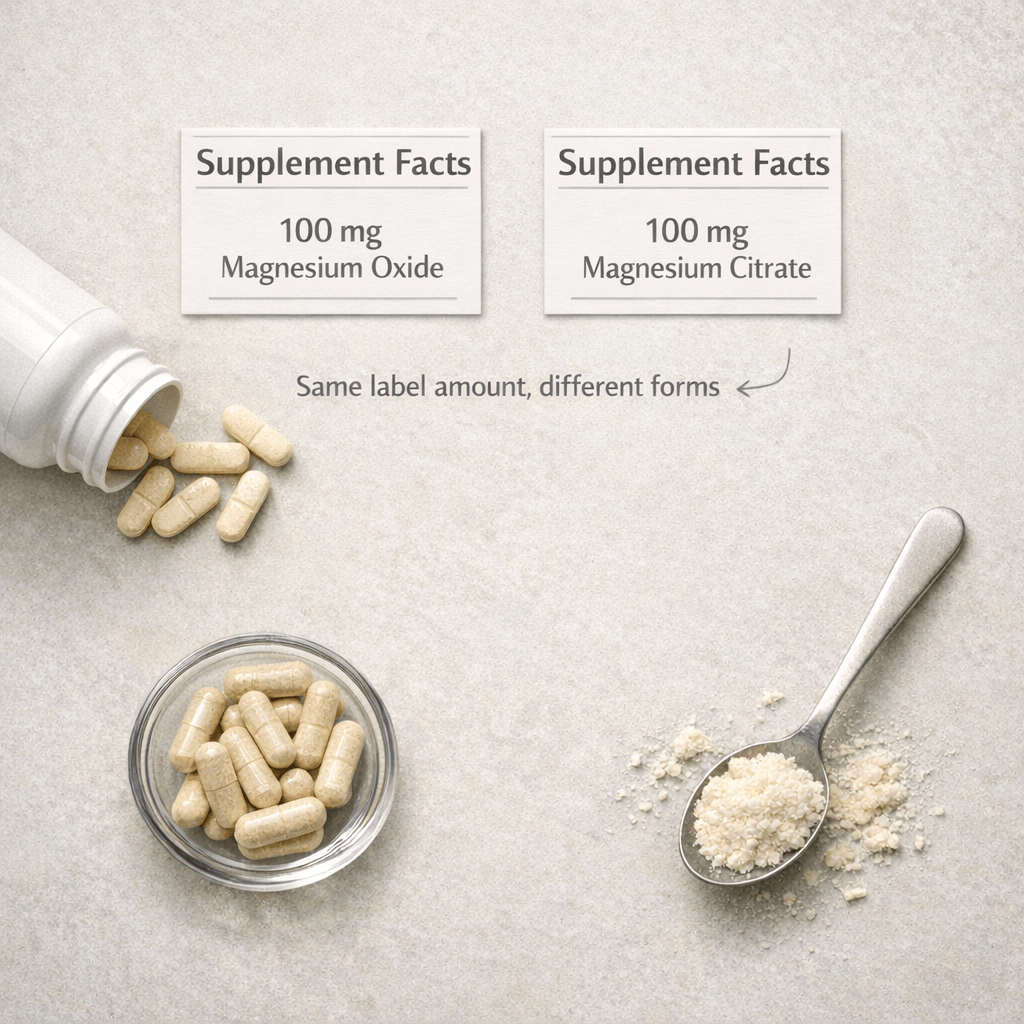
Magnesium form matters, but the label still does not calculate absorption
NIH reports that magnesium forms which dissolve well in liquid tend to be absorbed more completely in the gut. It also notes that small studies found citrate, chloride, lactate, and aspartate more bioavailable than oxide and sulfate. The words “tend to” and “small studies” matter: this is evidence about form behavior, not a promise that one form wins for every dose, product, purpose, or person. 5
The Supplement Facts panel declares the elemental magnesium amount, while the parenthetical source may identify magnesium oxide, magnesium citrate, or another form. The declared elemental amount supports a dose comparison. The source adds relevant form context. Neither line predicts the milligrams a reader will absorb.
For the amount distinction, see What Is Elemental Magnesium? The broader magnesium guide keeps form evidence, serving context, and tolerability separate.
Preparation is not proof
Standardized, chelated, liposomal, and extract wording answer different questions
A botanical standardized to a named constituent tells you something about the constituent content the label declares. An extract ratio or powder description tells you about the preparation basis. The guide to extracts and powders explains why those are useful identity and concentration details, not measurements of absorption. 3
“Chelated” describes a chemical association or ingredient form, while “liposomal”, “phytosome”, “micellar”, and similar terms describe formulation or delivery strategies. Piperine may also be added to some botanical products for an absorption-related purpose. None of that wording alone shows the size of the effect, identifies the comparator, proves that the finished product matches a study, or establishes a better clinical outcome. 9
Turmeric and curcumin are a useful example because the market contains many enhanced-delivery claims. Read the exact curcuminoid amount, preparation, delivery wording, and supporting study as separate pieces of information.
Turn marketing into questions
A useful absorption claim should survive five checks
Start by identifying the exact claim. “Designed for absorption” describes an intention. “Three times more bioavailable” makes a comparative claim and needs a clear comparator. “Clinically studied” is meaningful only when the study matches the finished product or when the brand carefully limits the claim to the tested ingredient.
Five questions for a “more bioavailable” claim
- Compared with what?
- Look for the named form, formulation, or reference product.
- What was tested?
- Check whether the study used the same finished formula or the exact ingredient and formulation the claim actually refers to.
- At what dose?
- Confirm that the studied amount and serving conditions match the marketed comparison.
- In whom?
- Human evidence in a relevant population is more informative than a laboratory model for a human absorption claim.
- What was measured?
- Separate blood or absorption markers from symptom, performance, or health outcomes.
A transparent answer does not guarantee that a product is best, but it makes the claim interpretable. Missing comparator, dose, or study details should remain uncertainty rather than being replaced by a form ranking or a generic absorption multiplier.
The separate analysis of the 30.7% calcium bioavailability study shows why a population-level estimate cannot be applied as universal supplement-label math.
NutriDetector approach
Keep the declared amount, form, and absorption claim on separate lines
NutriDetector reviews supported ingredient identities, declared amounts per listed serving, source and form wording, preparation or standardization details, serving context, blend transparency, and the surrounding formula.
When supported delivery-form wording such as liposomal or phytosome is recognized, it remains formulation context rather than an assumed absorption multiplier, clinical benefit, or universal form ranking.
The analysis organizes what the label discloses and keeps missing amounts, unclear comparators, and unsupported certainty visible. It does not substitute a label reading for laboratory testing or personal medical assessment.
Analyze the complete label
Read the declared amount first, then put the form claim in context.
Review the declared amount, ingredient form, serving context, standardization or delivery wording, blend transparency, and surrounding formula in one label analysis.
Questions and boundaries
Supplement bioavailability FAQ
Direct answers about absorption, label amounts, ingredient forms, and “more bioavailable” claims.
What does bioavailability mean in supplements?
In nutrition, bioavailability concerns the share of an ingested nutrient or compound that is absorbed and becomes available for use or storage under defined conditions. It is not a universal score printed on the product label.
Is bioavailability the same as absorption?
Not exactly. Absorption is one step in the process. Bioavailability is broader and depends on what became available after the dose and how the study measured it. Neither concept automatically proves a clinical benefit.
Is bioavailability listed on Supplement Facts?
No. Supplement Facts declares ingredient amounts per serving and may name a source or form. It does not state a personal absorption percentage or the milligrams an individual will absorb.
Is % Daily Value a bioavailability percentage?
No. % Daily Value compares the declared amount in one serving with an FDA Daily Value. It does not report the percentage absorbed and is not an individual requirement.
Can I convert a label amount into absorbed milligrams?
Not with a generic multiplier. Absorption can vary with the ingredient, dose, formulation, food, study conditions, and person. A result from one study should not be applied to every product or reader.
Does higher bioavailability mean a supplement is better?
No. Greater measured availability under specific conditions does not by itself prove a better dose, safer product, stronger clinical effect, or better fit for a particular person.
Is magnesium citrate always better than magnesium oxide?
No. NIH reports that better-dissolving magnesium forms tend to be absorbed more completely and cites small studies favoring several soluble forms over oxide. That does not make citrate universally best for every dose, purpose, product, or person.
Do standardized, chelated, or liposomal labels prove better absorption?
No. Those terms may describe constituent content, chemical association, or a delivery strategy. Better absorption requires evidence that matches the formulation, dose, comparator, study conditions, and measured endpoint.
What can NutriDetector check on a bioavailability claim?
NutriDetector reviews supported ingredient identities, declared amounts, source or form wording, preparation and standardization details, serving context, blend transparency, and supported delivery-form signals when recognized. It does not turn those details into a personal absorption percentage.
Bioavailability, supplement-labeling, and advertising references
- National Academies of Sciences, Engineering, and Medicine. Guiding Principles for Developing Dietary Reference Intakes Based on Chronic Disease: Appendix D, Definitions. National Academies.
- National Academies of Sciences, Engineering, and Medicine. Dietary Supplements: A Framework for Evaluating Safety. National Academies.
- U.S. Food and Drug Administration. Dietary Supplement Labeling Guide: Chapter IV. Nutrition Labeling. FDA.
- Electronic Code of Federal Regulations. 21 CFR 101.36: Nutrition labeling of dietary supplements. eCFR.
- National Institutes of Health, Office of Dietary Supplements. Magnesium: Fact Sheet for Health Professionals. NIH ODS.
- National Institutes of Health, Office of Dietary Supplements. Calcium: Fact Sheet for Health Professionals. NIH ODS.
- National Institutes of Health, Office of Dietary Supplements. Vitamin C: Fact Sheet for Health Professionals. NIH ODS.
- U.S. Federal Trade Commission. Health Products Compliance Guidance. FTC.
- National Center for Complementary and Integrative Health. Turmeric: Usefulness and Safety. NCCIH.