
Zinc label comparison
Elemental Zinc vs Compound Weight: Why 15 mg Can Mean More Than 30 mg
The amount beside Zinc in a U.S. Supplement Facts panel is the label-declared elemental zinc per serving. A larger number elsewhere may describe the complete source compound, so the two numbers cannot be compared until their measurement basis is clear.
Short answer
Compare the zinc amount, not the loudest milligram number.
In U.S. Supplement Facts, “Zinc 15 mg (as zinc gluconate)” means the listed serving declares 15 mg of zinc. The parenthetical wording names the source and does not replace the zinc amount.
A separate “30 mg zinc bisglycinate” claim may use a different amount basis. Unless the claim also states how much zinc the source supplies, it is not a valid 30-versus-15 comparison.
Start with the amount basis
Elemental zinc is the zinc portion of a zinc-containing source
Zinc supplements usually supply the mineral through a compound such as zinc gluconate, citrate, acetate, sulfate, oxide, picolinate, or a chelated source. The complete source contains zinc plus the other chemical components named by the form. Its total weight is therefore not the same as the weight of zinc it supplies.
In supplement-label language, elemental zinc is the mass of zinc contributed by that source. NIH states directly that a Supplement Facts panel declares elemental zinc rather than the weight of the entire zinc-containing compound. 1
The word “elemental” describes the amount basis. It does not mean that a capsule contains loose metallic zinc, and it does not state how much zinc a particular person will absorb.
A U.S. panel does not need to print “elemental” beside the number. If the line says “Zinc 15 mg (as zinc gluconate)”, the 15 mg is already the declared zinc amount per labeled serving.
One headline, two measurement bases
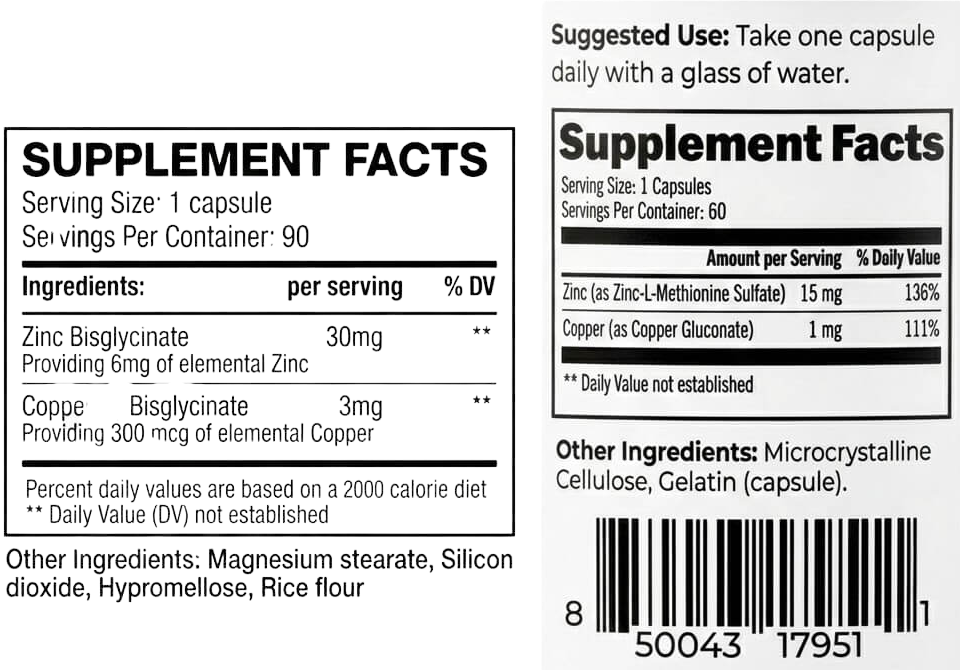
Why 15 mg can represent more zinc than a displayed 30 mg
The difference is the amount basis. In the comparison below, the 30 mg figure describes the complete zinc bisglycinate ingredient, while the same label separately states that it provides 6 mg zinc. The other panel declares 15 mg zinc. Those are the amounts that can be compared directly.
This does not establish a universal conversion for zinc bisglycinate. It shows why source-compound weight and declared zinc should be kept separate.
Read the regulated panel first
A U.S. Supplement Facts line separates the nutrient from its source
U.S. dietary supplement rules require the amount of a listed vitamin or mineral to be declared by the nutrient’s weight. FDA’s guide illustrates the rule with calcium carbonate: the panel lists the weight of calcium, not the entire salt. The same amount-basis rule applies to zinc. 2, 3
The source can follow the nutrient name in parentheses or appear through the applicable ingredient declaration. In “Zinc 15 mg (as zinc gluconate)”, Zinc is the nutrient, 15 mg is its amount per serving, and zinc gluconate identifies the source.
These rules describe current U.S. Supplement Facts labeling. Products sold under another jurisdiction can use different formats, so do not transfer a U.S. interpretation to a panel that follows a different labeling system.
The broader supplement label guide uses the same sequence: establish the serving, identify the named ingredient, read the amount and source, then separate what is disclosed from what remains unknown.
Five fields to read before comparing zinc products
- Serving Size
- How many capsules, tablets, lozenges, scoops, or milliliters supply the displayed amount?
- Zinc
- What zinc amount does the complete labeled serving declare?
- % Daily Value
- How does the declared amount compare with FDA’s 11 mg labeling reference?
- Source
- Is the zinc supplied as gluconate, citrate, acetate, sulfate, oxide, picolinate, a chelate, or more than one source?
- Directions
- Does the suggested daily use equal one listed serving or call for it more than once?
Compare like with like
Five zinc statements can look similar while answering different questions
The number is useful only when its label identifies what the number measures. The table keeps nutrient amount, source-compound amount, serving context, and front-label promotion on separate lines.
| Label wording | What can be read | What cannot be concluded |
|---|---|---|
| Zinc 15 mg (as zinc gluconate) | The listed serving declares 15 mg of zinc, supplied as zinc gluconate. | The full gluconate weight, absorbed amount, or personal need. |
| Zinc bisglycinate 30 mg, providing 6 mg zinc | On this specific label, 30 mg describes the source ingredient and 6 mg is its stated zinc contribution. | That every 30 mg zinc bisglycinate product supplies 6 mg zinc. |
| Zinc 15 mg (as citrate and gluconate) | The sources together provide a declared total of 15 mg zinc per serving. | How the 15 mg is divided between the two sources unless the split is stated. |
| 30 mg zinc bisglycinate on the front only | A 30 mg marketing claim is being made for the named material. | Whether 30 mg means zinc or complete compound weight without the facts panel. |
| 500 mg mineral complex on the front only | The complete promoted complex has a stated weight of 500 mg. | How much zinc it supplies. Added zinc with a Daily Value must be declared separately on a compliant U.S. panel. |
One amount needs two contexts
Per serving, per unit, and % Daily Value are not interchangeable
If a panel declares 15 mg of zinc and the Serving Size is two capsules, the 15 mg belongs to those two capsules together, not to each capsule. Compare products on the same per-serving or per-day basis rather than comparing the front number alone.
Directions can change the label-declared daily total. One serving taken once daily and one serving taken twice daily do not produce the same daily arithmetic, even when both panels show 15 mg per serving.
FDA’s Daily Value for zinc is 11 mg for adults and children age 4 and older. A 15 mg serving is therefore about 136% DV before label rounding. %DV helps place a serving within a general dietary reference, but it is not an absorption percentage, individualized target, or proof that a larger amount works better. 4
Daily Value and safety limits answer different questions. A %DV above 100% is not automatically unsafe, but it is also not evidence that the serving is needed or superior.
Source still matters, but differently
The form names the zinc source, not a guaranteed winner
Gluconate, citrate, acetate, sulfate, oxide, picolinate, and chelated sources are not interchangeable names. They identify the material used to supply zinc and may be relevant to formulation, evidence, tolerability, or a product’s specific claim.
The form name alone does not establish that one product is better absorbed, more effective, or more suitable for every person. NIH’s consumer guidance notes that it is not clear whether one supplemental zinc form is better than the others overall. 5
Compare the elemental amount first, then use the source wording as a separate field. The Zinc supplement guide covers common forms, dose context, claims, and safety in more detail. Zinc Carnosine has its own guide because the complete compound and its evidence context are not the same as a generic zinc-only claim.
“Zinc 15 mg (as zinc citrate and zinc gluconate)” declares 15 mg from the sources together. If the individual contribution from each source is not stated, do not assign the total to the form emphasized in marketing.
The stack changes the arithmetic
Zinc from separate products contributes to one daily total
Zinc can appear in a standalone product, multivitamin, mineral formula, lozenge, or another supplement. A transparent 15 mg line on one bottle does not show how much zinc is declared across the rest of the routine.
The adult Tolerable Upper Intake Level is 40 mg per day for people age 19 and older. Unlike the magnesium supplemental UL, this zinc limit includes total intake from food and supplements. Forty milligrams from supplements alone already reaches the adult total-intake UL before dietary zinc is counted. Children and adolescents have lower age-specific limits, and the UL does not apply to medically supervised treatment. 1, 6
NIH reports that 50 mg of zinc or more for weeks can interfere with copper absorption. That does not mean every 15 mg or 30 mg supplement causes copper deficiency. It means the declared amount, duration, diet, other zinc sources, and reason for use all matter. The related Copper guide explains the label context for that mineral. 1
Zinc supplements can also interact with quinolone and tetracycline antibiotics and penicillamine, while thiazide diuretics can affect zinc status. A label comparison cannot clear a medication schedule; regular medicine use belongs in a pharmacist or clinician review. 1
When comparing more than one U.S. supplement, add the declared zinc amounts associated with the intended daily use. Do not add zinc gluconate, citrate, or bisglycinate compound weights as though they were elemental zinc.
NutriDetector approach
Keep zinc amount, source weight, serving, and claims separate
NutriDetector reviews supported zinc identities, the disclosed zinc amount per listed serving, source or form wording, % Daily Value when shown, serving context, directions, multi-source transparency, and the surrounding formula.
A source-compound amount remains separate from elemental zinc. A combined zinc total is not silently assigned to one emphasized form, and an unclear front claim is not treated as a reliable zinc dose.
The analysis organizes what the label declares and keeps missing or ambiguous amount bases visible. It does not turn a form name, Daily Value, or larger headline number into a personal recommendation.
Analyze the complete label
Compare zinc on the same amount basis.
Check the declared zinc amount, source form, serving context, Daily Value, multi-source transparency, and surrounding formula in one label analysis.
Questions and boundaries
Elemental zinc and compound weight FAQ
Direct answers about zinc amounts, source compounds, serving size, Daily Value, forms, and total intake.
What is elemental zinc?
Elemental zinc is the zinc contributed by a zinc-containing source compound, excluding the rest of that compound’s weight. It is the amount basis used for the Zinc line in a U.S. Supplement Facts panel.
Does a Supplement Facts label need to say “elemental zinc”?
No. The milligrams beside Zinc in a U.S. Supplement Facts panel are already the label-declared elemental zinc amount per serving. A source can follow in parentheses without the word elemental appearing.
What does “Zinc 15 mg (as zinc gluconate)” mean?
It means the listed serving declares 15 mg of zinc supplied as zinc gluconate. The 15 mg is not the full weight of the gluconate compound and does not state how much zinc an individual will absorb.
Why can 15 mg represent more zinc than a displayed 30 mg?
It can happen when 15 mg describes zinc itself but 30 mg describes the complete source compound. In the article’s specific example, the 30 mg compound line explicitly states that it provides 6 mg zinc, while the other label declares 15 mg zinc.
Does 30 mg of zinc bisglycinate always provide 6 mg of zinc?
No. The 6 mg figure belongs only to the example that explicitly states it. Do not apply that relationship to every zinc bisglycinate ingredient or product.
Should I calculate elemental zinc from the compound myself?
Usually not. A U.S. Supplement Facts panel should already declare the zinc amount per serving. Generic percentages may not match the precise source material or the amount basis used by a separate front-label claim.
Does “Zinc 30 mg” mean 30 mg of elemental zinc?
On a correctly formatted U.S. Supplement Facts panel, yes. If the panel declares “Zinc 30 mg” and identifies the source separately, the 30 mg is the declared zinc amount. A front-label or compound-first claim such as “Zinc Bisglycinate 30 mg” may use a different amount basis, so the complete Supplement Facts panel still matters.
What is the zinc Daily Value, and is more than 100% automatically unsafe?
The U.S. Daily Value is 11 mg for adults and children age 4 and older. More than 100% DV is not automatically unsafe, but %DV is not a recommended dose, absorption estimate, or safety limit. Total intake and individual context still matter.
Do zinc amounts from different products add together?
Yes. Add the declared zinc associated with the intended daily use of each product, not the weights of their zinc source compounds. The adult 40 mg upper limit covers total zinc from food and supplements and is lower for children and adolescents.
Is one zinc form proven to be best?
No zinc form is universally best for every person or purpose. The form identifies the source, but its name alone does not establish better absorption, effectiveness, tolerance, or personal suitability.
What can NutriDetector compare on a zinc label?
NutriDetector reviews supported zinc identities, declared zinc amount per serving, source forms, % Daily Value when shown, serving context, directions, multi-source transparency, and the surrounding formula. Unclear amount bases and undisclosed source splits remain visible.
Zinc and supplement-labeling references
- National Institutes of Health, Office of Dietary Supplements. Zinc: Fact Sheet for Health Professionals. NIH ODS.
- Electronic Code of Federal Regulations. 21 CFR 101.36: Nutrition labeling of dietary supplements. eCFR.
- U.S. Food and Drug Administration. Dietary Supplement Labeling Guide: Chapter IV. Nutrition Labeling. FDA.
- U.S. Food and Drug Administration. Daily Value on the Nutrition and Supplement Facts Labels. FDA.
- National Institutes of Health, Office of Dietary Supplements. Zinc: Fact Sheet for Consumers. NIH ODS.
- National Academies of Sciences, Engineering, and Medicine. Dietary Reference Intakes for Vitamin A, Vitamin K, Arsenic, Boron, Chromium, Copper, Iodine, Iron, Manganese, Molybdenum, Nickel, Silicon, Vanadium, and Zinc: Zinc. National Academies.
- U.S. Food and Drug Administration. FDA 101: Dietary Supplements. FDA.